
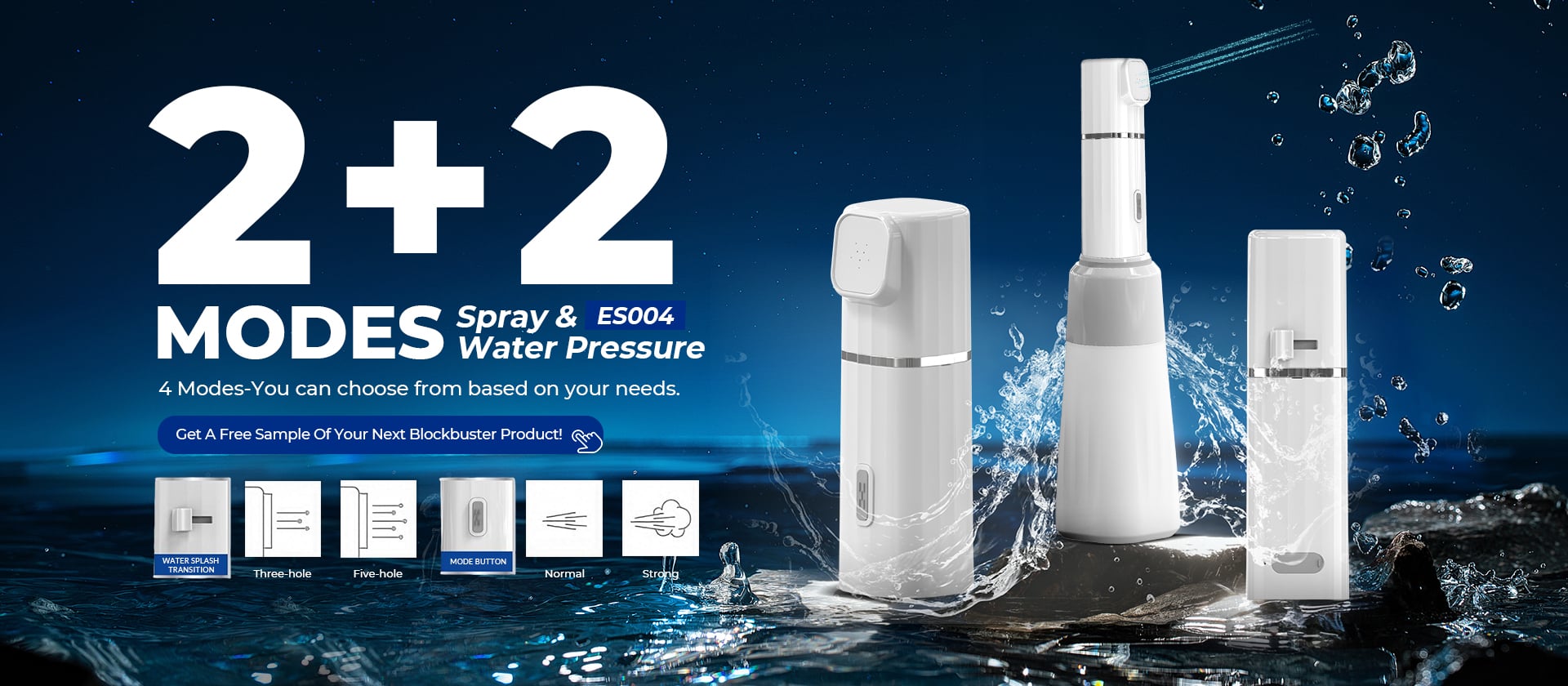
Electric portable bidets are moving into travel hygiene, postpartum care, elderly care and everyday personal-cleaning categories. For a brand or distributor, the difficult part is not finding a device that pumps water. It is balancing cleaning performance, runtime, waterproofing, portability and after-sales risk in one product specification.
Battery capacity is often the first number shown on a listing. In practice, pump efficiency, water-path resistance, nozzle count, hole diameter and the control program all influence the delivered spray. Comparing mAh alone can lead to a product with an impressive specification but weak flow, excessive noise or unstable performance.
A sourcing specification should separate low and high modes and define the test conditions. As an engineering benchmark, a single-nozzle platform may be specified at 350 mL/min on low and 420 mL/min on high. A detachable-bottle platform with a five-hole nozzle may reach 400 mL/min on low and 480 mL/min on high. These figures are useful only when the nozzle, test method and tolerances are also stated.
|
Evaluation Item |
What to Request |
Why It Matters |
|
Flow rate |
mL/min by mode and nozzle |
Replaces an unverified “powerful” claim with data |
|
Consistency |
Repeated tests across multiple units |
Reveals pump and water-path variation |
|
Spray pattern |
Photos at close and normal use distances |
Shows concentration, coverage and splash |
|
Noise |
Same distance and room conditions |
Important for travel, night use and care settings |
|
Residual water |
Test at realistic holding angles |
Determines usable capacity and convenience |
Do not stop at “What is the water pressure?” Ask for the test fixture, collection volume, timing method, nozzle code and sample quantity. Reproducible evidence is a better sign of engineering maturity than a polished specification sheet.
A bathroom device faces humidity, wet hands and accidental immersion. An RFQ can define IPX7 as a target, but production approval should depend on a relevant laboratory report and the tested construction. During design review, inspect button seals, housing welds, charging-port protection, wand interfaces and sealing recovery after repeated disassembly.
Type-C charging is convenient, but the connector type is not proof of waterproofing. Confirm whether operation is blocked during charging, how the port is sealed, how wet-connection risk is communicated, whether contacts are protected from sweat or corrosion, and whether the port cover still seals after repeated cycles.
An integrated tank creates a coherent product and stronger visual identity, but capacity, size and cleaning access must be balanced. A bottle-adapter design can reduce travel volume, yet it requires validation with different bottle necks, flexible bottles, tube lengths and noise conditions. A detachable tank is easier to clean and replace, but adds sealing interfaces and tolerance risks.
Before requesting samples, define the primary scenario: travel, postpartum care, assisted care or daily use. Then decide whether the user values a gentler spray or faster cleaning, whether the device must fit a pocket or luggage, and whether the sales channel adds battery-transport, packaging or instruction requirements.
Build the approval plan around five modules:
Each line needs a sample size, condition and acceptance criterion. A single “golden sample” cannot demonstrate production consistency.
A useful RFQ includes the destination market, annual estimate, first-order quantity, color, logo process, packaging, flow targets, nozzle option, waterproofing target, charging interface, battery transport documents, manual language, report requirements and milestones. For custom tooling, define mold ownership, wear-part life, engineering-change notification and spare-part support.
A strong electric portable bidet is not defined by one maximum number. It is defined by the balance of flow, waterproofing, noise, sealing, usability and manufacturing consistency. Converting marketing adjectives into testable clauses is the most direct way to reduce return, leakage and experience risks.
Does a larger battery always produce stronger flow? No. The pump, motor control, water path and nozzle determine output together. Compare products under the same test conditions.
Does IPX7 mean the product can never leak? No. It describes performance under defined conditions. Long-term reliability still depends on design, aging, assembly and use.
How many nozzle options should a buyer sample? When several hole patterns are available, compare flow, coverage, comfort and clogging risk rather than appearance alone.
To build an OEM specification for an electric portable bidet, include your destination market, forecast volume, target flow, tank architecture, color and packaging needs in the inquiry. This allows the supplier to propose a relevant structure, sampling plan and verification checklist.
 EN
EN
 AR
AR
 BG
BG
 HR
HR
 CS
CS
 DA
DA
 NL
NL
 FI
FI
 FR
FR
 DE
DE
 EL
EL
 HI
HI
 IT
IT
 JA
JA
 KO
KO
 NO
NO
 PL
PL
 PT
PT
 RO
RO
 RU
RU
 ES
ES
 SV
SV
 TL
TL
 IW
IW
 ID
ID
 LT
LT
 SR
SR
 SL
SL
 UK
UK
 VI
VI
 HU
HU
 TH
TH
 TR
TR
 FA
FA
 MS
MS
 GA
GA
 AZ
AZ
 KA
KA
 BN
BN
 SO
SO